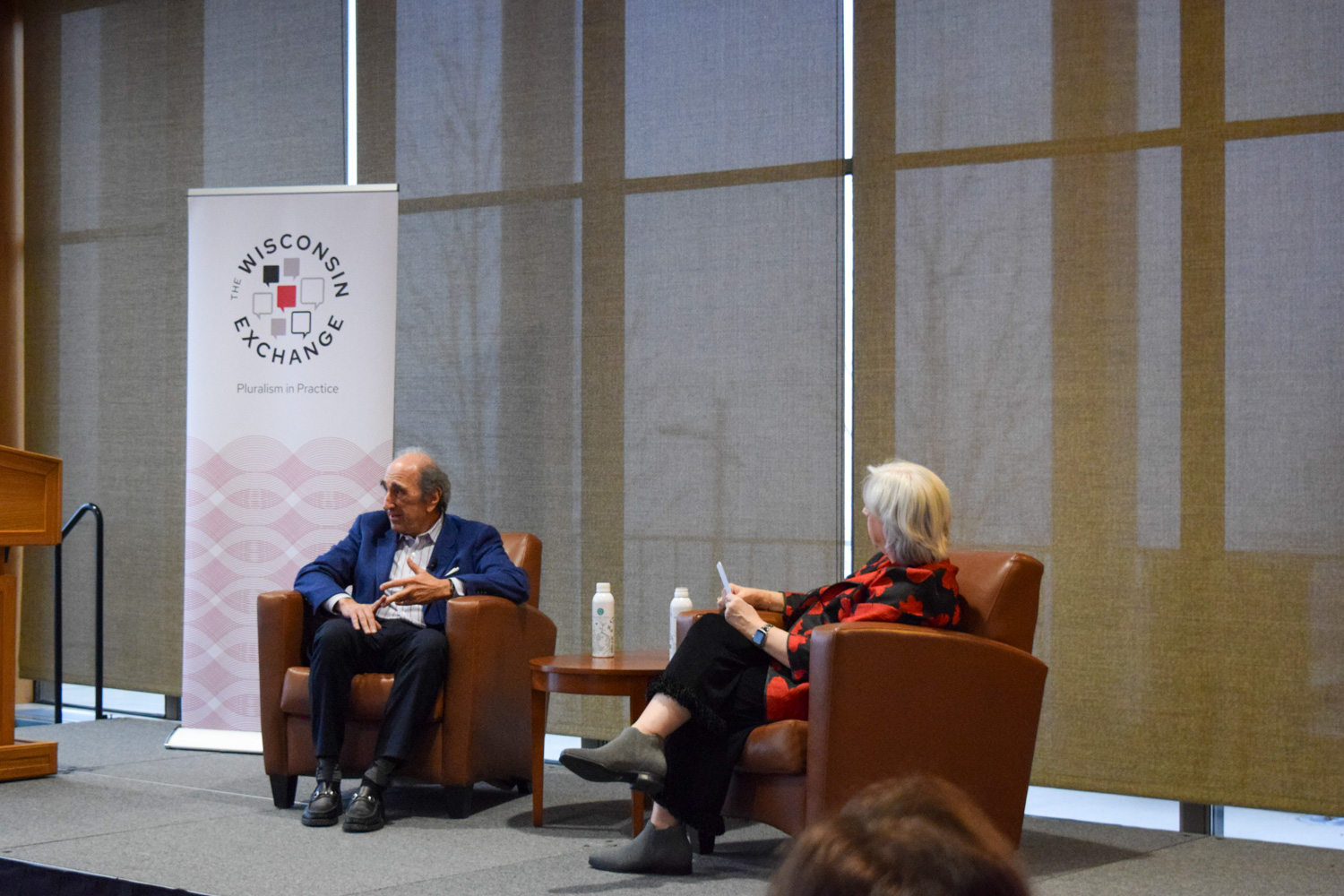
On March 5, over 80 students, faculty, alumni and community members gathered at the Pyle Center for “Democracy in the Balance: The Essential Role of Journalism in Advancing Civil Discourse,” a timely conversation about journalism’s role in strengthening democratic dialogue.
The event, presented in partnership with the Wisconsin Exchange: Pluralism in Practice, featured veteran media executive and journalist Andy Lack in conversation with SJMC Director Kathleen Bartzen Culver.
“[Journalism’s] role hasn’t changed from the time the Founders decided the First Amendment ought to have a free press. The role is to be honest brokers of information, to tell the story, whatever that story is, factually,” Lack said. “At the end of the day, it’s pretty straightforward – journalism is about getting the story right.”

This important event brought students, faculty, alumni and community members together to examine how journalism can strengthen democratic institutions, rebuild public trust and create space for meaningful dialogue across political and ideological divides – a central focus of the Wisconsin Exchange: Pluralism in Practice. The Wisconsin Exchange aims to foster environments where diverse viewpoints are expressed, debated and respected.
The discussion explored how journalism can help communities navigate political polarization, declining trust in institutions and the changing economics of the news industry. Throughout the event, several key themes emerged:
- The importance of local journalism in sustaining democratic communities. Lack discussed why he shifted his attention from leading major national media organizations to supporting nonprofit local outlets such as Mississippi Today and Deep South Today. The conversation explored how strong local journalism helps communities stay informed about issues that directly affect their lives – from education to public policy to economic development – while also creating space for shared understanding.
- Journalism’s role in fostering respectful engagement across differences. Lack and Culver examined how journalism can foster respectful engagement across differences – a key goal of the Wisconsin Exchange. Lack reflected on the press’s responsibility to present a range of viewpoints while maintaining a commitment to factual reporting.
- Declining public trust in media and institutions and the rise of news influencers. Lack explored how skepticism in media isn’t a new phenomenon and how news organizations can rebuild credibility. Culver and Lack also discussed the impact of news influencers and the kinds of ethics these influencers should be held to.
- Navigating polarization. Lack and Culver addressed how journalists can facilitate conversations about issues that divide communities. Drawing on insights from Lack’s work on the PBS series Breaking the Deadlock, the discussion emphasized the importance of creating forums where people with deeply different perspectives can engage respectfully and listen to one another.
“It’s almost patriotic to talk to each other and to take it as a responsibility to do better by each other,” said Lack. “Compromise is not a dirty word. It’s a tough word to deal with and it requires work. But I think it’s been demonized in ways that I don’t think as a country we envisioned.”

After Lack and Culver’s conversation, attendees participated in a lively Q&A session, raising questions about the government’s influence on corporate journalism, labor unions and their effect on newsrooms, economic journalism and the ethics of celebrity journalists.
Following the discussion, participants gathered for a reception that offered additional opportunities for informal dialogue and networking. Local journalists, students, faculty and alumni shared perspectives on the evening’s themes and connected over shared interests in civic discourse and journalistic integrity.
Events like “Democracy in the Balance” reflect the ongoing efforts by the School of Journalism and Mass Communication and the Wisconsin Exchange initiative to foster thoughtful dialogue across differences and explore journalism’s evolving role in supporting democratic communities.