
Through community-based learning, journalism students work alongside foster care staff and families to build campaigns that support Sheboygan County Foster Care
By Sophie Wooldridge (X’26)
On the third floor of an office building, students are packed tightly into a small room where a tripod sitting atop a table is the only thing separating them from their interview subject. Sheboygan County foster mom Mandy Boge sits in front of the tripod-secured iPhone, holding back tears to keep a steady composure on camera as one student — taking the role of the primary interviewer — inquires about her current experience being a foster mom to two children.
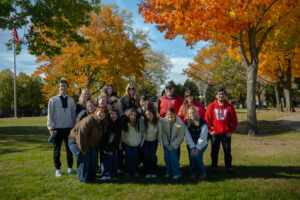
In the next room over, more students sit around a large conference table with laptops in front of them, taking detailed notes as they listen carefully to the Sheboygan County Foster Care (SCFC) staff describe their goals of encouraging more families to open their homes to foster children. These 16 students from the School of Journalism and Mass Communication at the University of Wisconsin–Madison traveled from downtown Madison to this community along Lake Michigan to fulfill some of the core pillars of Community-Based Learning: They are here to listen, learn and collaborate.
 The students are enrolled in Professor Doug McLeod’s section of Journalism 445 and met before the break of dawn on the morning of Oct. 28 outside of Vilas Hall on campus to make the two-hour trek to Sheboygan. The course, Creative Campaign Messages, introduces students to the creative aspects of message development for advertising, public relations, and other strategic communications. McLeod’s section of the course is designated as a Community-Based Learning course, meaning that students in the course engage in hands-on, public-facing projects, the result of intentional collaborations between the instructor and community partners. Since 2018, McLeod has collaborated with UniverCity Alliance, a campus unit that engages local governments across Wisconsin to identify projects and areas of collaboration, ensuring UW knowledge and resources are leveraged to support statewide communities.
One student, senior Sarah Van Der Vaart, appreciated that the course is rooted in real-life partnerships.
“We’re all very passionate about marketing and strategic communication, so I think that brings a lot to the table,” Van Der Vaart said. “It’s a very good cause for trying to put kids in placement for homes that they need to be put in, so I think it’s driving us to have that motivation to do the best work that we possibly can for this project.”
McLeod said that his course trains students in how to develop creative campaigns that will not only inform but also mobilize community members. SCFC’s goals are to encourage more families in Sheboygan County to open their homes to foster care and to communicate SCFC’s goal of reuniting children with their biological families.
“Ideally, they can use the messages that my students produce to accomplish organizational goals,” McLeod said. “They may also get ideas for what and how to communicate with the constituents and stakeholders.”
Grounded in real-world impact
Students conducted preliminary interviews and talked with SCFC staff during the site visit to develop a fuller understanding of some of the department’s goals and desired deliverables for the end of the partnership.
Once everyone settled around the conference table and listened to Alternate Care Supervisor Sheboygan County Health and Human Services Rebecca Zak explain the foster care system and their goals for the partnership, the students quickly fell into their roles as strategic communicators, rattling off questions about the Sheboygan community and how its members perceive the foster care system. Key struggles that Zak highlighted are mobilizing people to make the step to be a foster parent and combating misconceptions about foster care.
 “Our hope is to dispel the myths and generalizations that are often seen and heard about the Child Protection System and foster care, and to replace them with understanding, compassion, and a deeper appreciation for the complexity and importance of this work,” Zak said.
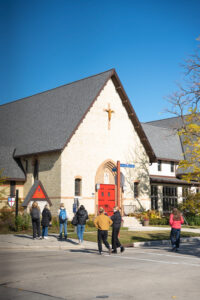
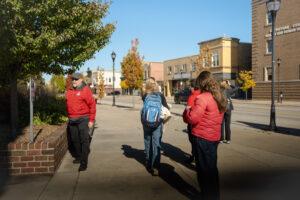
After learning about how SCFC operates in the community and asking questions for background information, the students conducted on-camera interviews of Zak and Boge separately, which will be used in promotional materials the students create for the campaign. They also explored downtown Sheboygan and walked along the lake, capturing content to localize their campaign materials.
Originally from Sheboygan, Van Der Vaart has had a special stake in the work they are conducting. She said developing a campaign for SCFC has given her a new perspective on her hometown’s community.
“I never really knew much about the Sheboygan foster care system,” Van Der Vaart said. For Van Der Vaart and her peers, the insight from the staff and Boge’s personal accounts as a foster mom were valuable and motivating for the remainder of the project.
Making Connections
In community-based work, it’s important to ensure that the goals of the project are well-defined and understood from the outside. On campus, units including UniverCity Alliance and the Morgridge Center for Public Service support community-based partnerships to make sure students are meeting community partners’ goals. For example, UniverCity Alliance helped connect Sheboygan County with several classes, including McLeod’s, at UW–Madison to work on projects.
Unique to this semester, an additional class in the School of Journalism and Mass Communication is also working with SCFC. Journalism 445 is working this semester in tandem with Journalism 463: Digital Media Strategies, led by SJMC teaching faculty III Debra Pierce. Students in Journalism 463 completed in-depth research to inform their media and creative strategies for SCFC. Then, McLeod’s students used the insights from Pierce’s class to develop their campaign.
“This unique approach will help students in both courses practice cross-team collaboration and project hand-offs, just like what happens at real agencies,” Pierce said. “As the client, the team at Sheboygan County Foster Care also benefits, in that they’ve had more students working on a range of ideas to help them achieve their goals.”
The Morgridge Center for Public Service also plays a role in supporting courses like McLeod’s and Pierce’s by awarding the community-based learning designation and offering resources to instructors and students to make partnerships easier and more effective for campus and community stakeholders.
 UCA Managing Director Megan McBride said connecting local organizations with students, through resources like community-based learning or applied research projects, provides communities with fresh ideas and gives students the opportunity to expand their real-world skills.
“We can be our own toughest critic, so I think it can be really fun to have that outside perspective come in and reinspire communities in some ways around the work they’re doing and about what makes their community special,” McBride said.
For Zak, the partnership with SJMC renewed her awareness of how important it is to communicate the ongoing need for compassionate families.
“Being around students who are so curious and eager to learn reminded me of why I pursued this career – because helping children and families has always been at the core of who I am,” Zak said. “This experience reignited a passion in me and reminded me how meaningful this work truly is.”
Community to Classroom
To McLeod, who has been running this CBL course for a decade, the most effective way to learn is to learn by doing.
 “The best experiences are those that take the students out of their comfort zone,” McLeod said in an emailed statement.
Before filing into that large, potentially intimidating conference room to learn about a system unfamiliar to them, the students may have been on edge from the responsibility of developing a campaign that could encourage families to open their homes to foster care. But after hearing the vulnerable account of a Sheboygan County foster mom and getting their feet on the ground in the community, a quiet energy settled among the students as they prepared to tell the story of Sheboygan County Foster Care.
Since the visit, the students have been working hard developing a campaign book that accumulates strategy, objectives and deliverables — from yard signs and billboards to documentary-style clips to communicate what SCFC is. The site visit and the cause overall, Van Der Vaart said, have motivated her and her classmates to reach the best possible outcome for their community partner.
“I just really want to make a difference in the community that I grew up in,” Van Der Vaart said. “I hope our campaign turns out the best that it can be, so they can actually utilize it in the real world.”
Instructors interested in community-based approaches to teaching and partnerships with Wisconsin municipalities are encouraged to connect with the Morgridge Center for Public Service and the UniverCity Alliance.