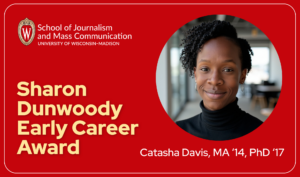
Catasha Davis, Ph.D., is a strategic communication and research leader with more than a decade of experience translating complex research into decision-ready strategy across public health, philanthropy, defense, and nonprofit sectors. Her work sits at the intersection of qualitative research, narrative strategy, institutional governance, and applied communication design. Dr. Davis most recently served as a Social and Behavioral Administrator at the National Institute on Aging, where she worked on clinical trial recruitment oversight and corrective action policy. In that role, she tracked recruitment performance across studies, contributed to compliance strategy, and supported policy mechanisms designed to strengthen accountability and improve equitable participation in federally funded research. She began her federal career as a Fellow at the National Cancer Institute, focusing on strategies to improve African American recruitment and participation in clinical trials.
That early work shaped her sustained commitment to equity-centered research, institutional trust, and evidence-based communication strategy. Dr. Davis later served as a Senior Researcher at FrameWorks Institute, where she designed and executed qualitative and mixed-methods research to inform national communication strategies. Her portfolio included advising the Missouri Foundation for Health on framing gun violence prevention; partnering with the Centers for Disease Control and Prevention and ChangeLab Solutions on tobacco-related health disparities; supporting the National Physical Activity Plan Alliance in advancing public understanding of physical activity; and contributing to child policy communication initiatives with Leading for Kids. Across issues, she translated research into narrative strategy that shaped public engagement and policy conversations. In the national security space, she has worked as a Communication Specialist and Strategist with Parenthetic, advising senior U.S. defense leaders in air and space on internal and external communication strategy. Her work supported executive messaging alignment, stakeholder engagement, and strategic narrative positioning in high-stakes operational environments.
Throughout her career, Dr. Davis has led focus groups, stakeholder interviews, perception analyses, and communication audits that inform institutional strategy. She integrates AI-enabled research workflows into qualitative synthesis while maintaining methodological rigor and ethical application. She is currently working to build a strategic research and communication consulting practice called Point North, focused on helping organizations align messaging, perception, and strategy in complex environments. Dr. Davis holds a Ph.D. in Mass Communication from the University of Wisconsin–Madison, along with an M.A. in African American Studies and a B.A. from UW–Madison.
What does receiving this award mean to you?
Receiving this award is deeply meaningful to me. Anyone who has gone through graduate school or pursued a PhD knows how many years you spend working to prove, to yourself and to your professors, that you belong in that space and are worthy of the degree you seek. This award affirms that I did more than meet that standard. It signals that I not only earned the degree, but that my work and contributions met or exceeded the expectations of the faculty who trained me.
What is your favorite memory from your time at the SJMC?
I have many fond memories of my time at SJMC, but one that stands out most is having an office in the graduate lounge. It was always lively, with people stopping by to chat, share ideas, or ask for help. It was where I met with students, worked through regression homework with other graduate students, and where we naturally built a sense of community.
That space captured the spirit of SJMC for me: intellectually curious, collaborative, and deeply connected.
Who is one SJMC professor who made a lasting impact on your career, and why?
Professor Mike Wagner made a lasting impact on my career. He stepped in as my advisor when my original advisor left UW–Madison, at a moment when I could easily have felt uncertain about my path forward. I still remember his words: “I will be your advisor. Whatever you want to do. I will be your advisor.” At the time, he already had multiple advisees, running multiple research groups, and had no shortage of responsibilities. Yet he made space for me anyway.
That moment shaped how I approach mentorship and leadership in my own career. No matter how busy I am, I try to lead with the same generosity he showed me, making time for people and opportunities that matter.
What is one thing you learned at the SJMC that you have carried with you throughout your career?
One of the most important things I learned at SJMC was the value of true research collaboration. Working in research groups, especially the Health Communication Group, MCRC, and PACE, I saw how much creativity and innovation can emerge when people bring different perspectives to experimental design and problem-solving. It taught me that strong research is rarely a solo endeavor.
Through those research groups, I deepened my appreciation for mixed-methods research and learned how to combine qualitative and quantitative approaches by leaning into the strengths of others. That experience shaped how I work today. In my consulting and research practice, I lead with curiosity, ask a lot of questions, and build research frameworks that integrate multiple methods and viewpoints to help clients find clear, actionable solutions.
What has been keeping you busy since your time at the SJMC?
Since my time at SJMC, I have stayed deeply engaged in research addressing complex strategic communication challenges. My work has focused on designing and leading research that helps organizations understand how people interpret information, make decisions, and respond to messaging in high-stakes contexts. This has included research on communicating about tobacco-related health disparities, gun violence prevention in Missouri, clinical trial recruitment and participation, and building systems to detect and respond to misinformation online, among other things.
Across these projects, I have continued to do what SJMC trained me to do best: ask the right questions, design rigorous studies, and translate research findings into practical strategies that help institutions communicate more effectively.
What are you currently focused on in your career?
I am currently focused on shaping the next phase of my career. After leaving the National Institute on Aging at the NIH last year, I have been intentionally building a consulting practice called Point North. Through this work, I partner with organizations to tackle complex communication and research challenges, develop strategic insight frameworks, and translate evidence into clear direction for decision-making.
This period has been both a transition and an opportunity to design a career that blends rigorous research, strategic communication, and real-world impact.