
It’s a long way from a J202 final pitch presentation in Vilas Hall to the mic on stage at a stand-up comedy club. But for these School of Journalism and Mass Communication (SJMC) alumni, storytelling and connection bridge the distance.
In an increasingly fractured world, comedy today feels like a sanctuary where people can laugh together, recognize themselves in one another, and forget about darkness and division for just a minute.
These alumni use laughter to find human connection, shaping culture in writers’ rooms, on stage, and through their phone screens. While they work in different roles, they’re united by their ability to find the strings that tie us at the center of their work.
They say their time in the SJMC taught them not only how to write, but also how to connect. And connection is the bridge between humor and humanity.
Here’s where they are bringing the laughter and how they brought Madison with them:
Laugh, Then Listen

Charlie Berens (BA’09) took his Midwest charm and brought it nationwide. Best known for his sketch series, “The Manitowoc Minute,” Berens has accumulated over 10 million followers on social media with his comedic spin on Midwest culture.
While he was attending the SJMC, Berens witnessed the early rise of social media, and the growing idea that news and comedy could intertwine. It was here that Berens recognized the potential connection between the storytelling skills he was learning in the classroom and the career he would eventually build.
“There was quite a bit in those early days of just figuring out how to write in a way that connects with people,” Berens said.
By 2017, Berens had found himself working as a stand-up comedian, selling out theaters across the Midwest. However, he realized he wanted to use his talent of connecting with people to make a difference in the world, beyond simply making them laugh. Outside of his performances, he’s served as an ambassador for Feeding America Eastern Wisconsin and has led an advocacy push across Wisconsin to raise awareness about the energy and water consumption of AI data centers.
“There’s a lot of division in the world today, but there are issues we really do agree on,” Berens said. “And finding those issues and giving people real tangible things that they could do so it’s not just doom and gloom.”
Throughout his career, Berens has established himself as a communicator, advocate and comedian. By sticking to his Wisconsin roots and doubling down on Midwest culture, he’s brought his personality nationwide.
“Once you can laugh, you can listen,” Berens said.
Going Viral, Staying Human

After landing a job at UW-Madison’s Camp Randall as a sports writer for the Athletic Communications Department, Justin Mozer (BA’12) realized he had a natural aptitude for writing. He switched majors, found his place in the SJMC and began building a career rooted in storytelling and strategy.
Following graduation, Mozer spent a decade with ThePostGame, a digital sports media company and content studio, where he worked across content, marketing and brand strategy. Throughout each role, he found himself returning to the communication skills he first developed in Madison.
“Being able to communicate effectively, and honestly, just being a good writer has been really, really important for my career,” Mozer said.
Although Mozer always enjoyed comedy, he never expected to work in the entertainment industry. That changed when an opportunity with The Laugh Factory introduced him to a rapidly evolving side of digital media.
In the 2010s, The Laugh Factory was an internet sensation, famous for its videos of comedians. But as platforms evolved, comedians began to build their own audiences online, and changed the role traditional comedy institutions played in entertainment. Throughout his time with The Laugh Factory, Mozer helped to reimagine the company as a digital-first media brand, overseeing content, marketing and production strategy while developing new ways to collaborate with comedians online.
Today, Mozer works for another internet sensation, TikTok, where he works on the development of sports, entertainment, comedy and music media. Through managing departments, teams and data, he has continued to explore what makes comedy resonate in today’s media landscape.
Despite working across different industries throughout his career, Mozer said understanding people and creating relatable content remains the foundation of everything he does.
“When you get down to it, [comedy] is really about ‘What’s the human experience? What can people relate to?’” Mozer said.
Behind the Laughs

Kate Manegold (BA’10) didn’t initially expect herself to end up in the entertainment and comedy industry. While at the SJMC, she explored roles with magazines, newspapers, as a public relations intern and more. Storytelling and the ability to work with other people carried Manegold through her undergraduate years and straight to her professional career.
After a few years in the corporate world, Manegold found herself with a job at Amazon. Despite having no formal experience in entertainment, Manegold said the SJMC had prepared her to conquer challenges with an open mind and confidence.
“I remember learning so much from those group projects,” Manegold said. “I’m always so grateful for the experience of being able to work well with other people.”
Today, Manegold works on social strategy for Netflix’s comedy division, Netflix Is A Joke, developing content and managing talent for various shows. Like any career professional in the comedy industry, Manegold balances her work day with the unpredictability and personalities that comes with the fast-paced environment.
“No two days are the same. You have to be able to basically drop whatever you thought you were going to get done that day for whatever emergency comes up,” Manegold said.
For anybody interested in comedy and entertainment, Manegold is a testament to how hard work and dedication can get you anywhere in the field. From working as a marketing manager at Capital One to creating content with personalities like Bert Kreischer and Shaquill O’Neal, Manegold’s career path has been anything but “normal.” She prides herself on her curiosity, adaptability and her ability to work with others, all skills she said stemmed from the SJMC.
“You don’t have to be a specialist,” Manegold said. “You just have to really be willing to learn and understand different communities.”
Laughing through the Headlines
Brittany Radocha’s (BA’11) interest in The Daily Show was sparked in an introductory journalism course with Professor Hernando Rojas. It was there she first learned about Jon Stewart and his vision of blending politics with satire, and Radocha was fascinated.

The Daily Show stayed with her while she went abroad, becoming a way to stay connected to home, keep up with the news, and find a sense of comfort in the unfamiliar. This connection only deepened over time, shaping not just what she watched, but the kind of work she hoped to do.
Just after graduating from the SJMC, Radocha landed a position as a production intern with The Daily Show. Over the years, she’s worked her way to become a two-time Emmy-award winning producer, and helps oversee the graphics department, produce in-studio segments, and support many departments at Paramount.
Her day moves quickly between brainstorming sessions, script revisions, rehearsals and last-minute changes that are driven by the nonstop news. Radocha said the fast-paced environment feels familiar, and she credits the SJMC for preparing her to manage tight deadlines, collaborate under pressure and be ready for anything.
“We start everyday with a blank sheet of paper,” Radocha said. “And by the end of the day we have a show to put out to the world.”
Like any news production, The Daily Show’s purpose is to inform its audience. By using satire and comedy to deliver its message, the show offers viewers a different way to process their news. Radocha said she enjoys finding moments of humor that allow the show to connect with audiences at a human level.
“I think that’s one of my favorite things about working at the show,” Radocha said. “When the world looks dark, we can all sit in a room, and we can find some light in it together.”
Lights, Camera, Humanity
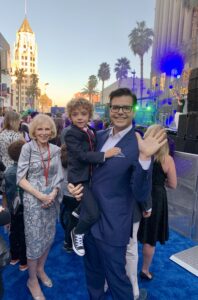
Before becoming an Oscar-nominated screenwriter, Phil Johnston (BA’94) spent the early years of his career in broadcast journalism. After graduating from the SJMC, Johnston worked as a weatherman and news anchor across the Midwest before eventually making the leap to attend film school.
Although journalism offered Johnston a stable career path, and he was already well on his way to climbing the leadership ladder, storytelling had always been at the center of his life.
“And that [decision] changed my life probably more than anything else,” Johnston said. “A lot of people thought I was insane to leave behind a good, and sort of flourishing, career to do that.”
Johnston said his years in journalism helped shape the screenwriter he would eventually become. Reporting placed him face-to-face with people during some of the most emotional and vulnerable moments of their lives.
“Something I learned at Madison about covering breaking news, for instance, that if there’s a house fire, obviously the best pictures are of the flames. But the story is when you turn around and see the people who are affected by it,” Johnston said.
That ability to connect with people at a deep level was a skill that Johnston nourished from his early career to now. He said his background in journalism taught him to approach characters with the same curiosity he once carried as a reporter.
After graduating from film school, Johnston went on to write and co-write films, including Cedar Rapids, Wreck-It Ralph, Zootopia and Ralph Breaks the Internet. His work on “Ralph Breaks the Internet” earned him an Academy Award nomination, cementing his place in the entertainment industry. His career in journalism never left him. It just transformed into a deeper understanding of humanity, and what it means to connect with others.
“Whenever I’m writing a screenplay I interrogate the characters in my mind, or I write down a series of questions that I would have asked as a journalist,” Johnston said. “All those kinds of things that just give you insight into the human condition.”
Punchlines with Purpose

Long before Josh Burstein (BA’08) stepped onto the stage, he entered the world of political storytelling and campaigning. After graduating from the SJMC, Burstein worked on former President Barack Obama’s campaign, learning to communicate complex ideas through digital media. Later, he started working as the creative director for the Democratic National Convention.
His world suddenly revolved around politics, creating a constant atmosphere of urgency and pressure. Burstein realized he needed an outlet to channel his creativity and release the tension that had become part of his daily life. That search led him to a stand-up improv class in Washington D.C., where he began experimenting with satire and comedy. And it didn’t take long for him to realize that the skills he was developing through improv weren’t exclusive to the stage.
“What is any presentation in any room, if not stand up, without any good jokes?,” Burstein said. “My entry point was treating it like a skill that I won’t regret.”
While looking back on his undergraduate career, Burstein credits the SJMC with helping him develop a strong communication style, one that continues to help him on and off the stage. As a student, he found himself connecting with others from different backgrounds, with different perspectives and different visions for the future.
“As a comedian, especially, you want to speak truth to power, sure, but I think it’s number one connecting with audiences that are different than you and making them think about stuff,” Burstein said.
Today, Burstein continues to combine comedy with political advocacy, using his platform for grassroots storytelling and working as creative advisor for the Democratic Party. His studio, Green Screen Productions, uses smart comedies to offer hope and unity on tough political issues.
For Burstein, the goal has never simply been to make audiences laugh. Instead, he sees comedy as a way to create understanding, spark curiosity and lead conversations with empathy rather than division.
“If you love Wisconsin, Wisconsin loves you back,” Burstein said.