This May, the Public Tech Media Lab (PTML) hosted a Digital Investigations Bootcamp, the first intensive, hands-on open-source intelligence (OSINT) training program in the Midwest. The two-day, in-person bootcamp was designed specifically for journalists, OSINT practitioners, editors and newsroom researchers and aimed to equip attendees with the critical skills necessary for digital investigations.
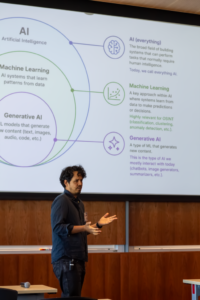
“We designed this bootcamp to give journalists agency,” said Tomás Dodds, SJMC assistant professor and Director of PTML. “OSINT, to some extent, democratizes investigative power; it points journalists toward freely available data and tools they can use to tell different kinds of stories.”
Led by Dodds as well as open source investigation experts from the University of California, Berkeley Human Rights Center, Guillén Torres and Gisella Pérez de Acha, the bootcamp offered participants the opportunity to gain hands-on technical training with a variety of OSINT tools, such as geolocation, chronolocation, and digital verification. To put that training to the test, the trainers programmed an AI bot to simulate a breaking-news disinformation event and had participants verify information in real time to determine its trustworthiness.
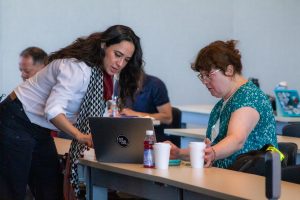
“I think newsrooms are really falling behind in the era of AI-generated and AI-powered disinformation. Without these skills and these tools, journalists will never be able to catch up to the digital times,” said Pérez de Acha. “What we’re providing them is the training that can be taken back to their newsrooms and serve as a sort of infrastructure for a really complex information environment.”
For Kenny Jacoby, an investigative reporter at USA Today, visual investigations were an area in which he wanted to improve. The Digital Investigations Bootcamp provided him the space to gain applicable skills in chronolocation and geolocation, advanced search techniques, social media analysis and verification, safety and security practices and ethical protocols, all of which he hopes to incorporate into his own workflow.
“Being able to detect what things are AI-generated is going to be more and more important moving forward,” Jacoby said. “This [bootcamp] helped me put the type of work I’m accustomed to doing into a different mindset of how to accomplish it.”
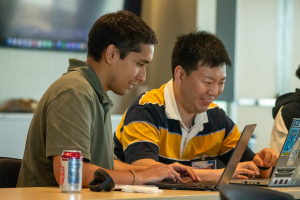
The bootcamp not only served professional working journalists – students also had the opportunity to expand their skillsets and build their resumes.
“I think it’s unique to be able to market yourself as a journalist who can do things that most people aren’t even aware of,” said Anna Smith, a senior at the SJMC.
In addition to enhancing their resumes, students were also thrilled to learn from world-class experts with extensive experience in digital investigations, public communication and democratic resilience.
“[PTML] brought in some really fantastic, ahead-of-the-curve, cutting-edge people in this field and I’m really grateful they were able to bring this to Wisconsin,” said Mary Bosch, a senior at the SJMC.
After the success of their first bootcamp, PTML is already gearing up for another training next year.
“I am happy to announce that we will be doing another bootcamp next year, with a stronger focus on digital investigations and cybersecurity,” Dodds said.
Find more information about the Public Tech Media Lab and future Digital Investigations Bootcamps at the PTML website.