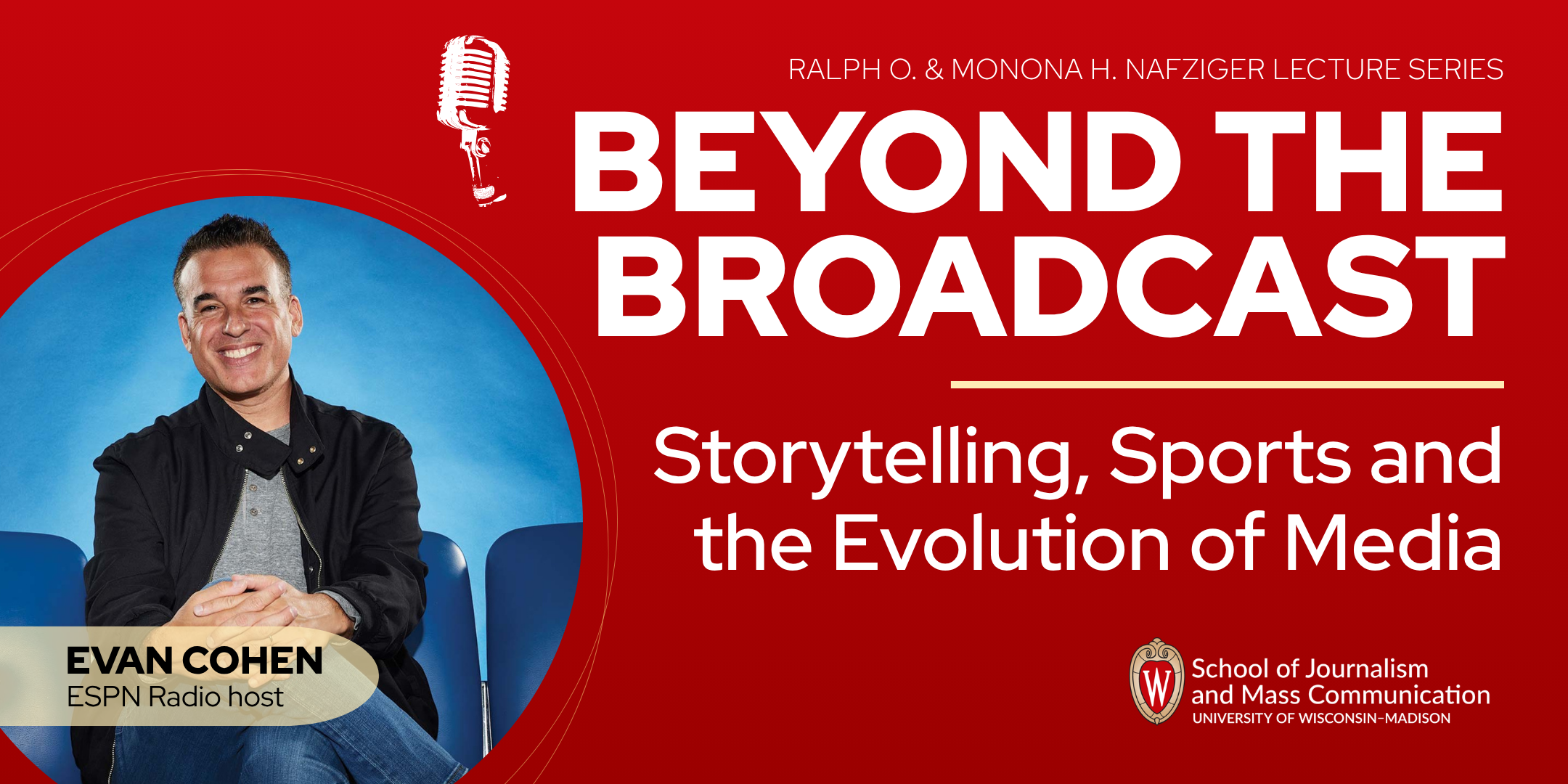
ESPN Radio host and UW–Madison alum Evan Cohen (BA’02) will return to campus on October 22 for an interactive talk and Q&A session. Cohen is best known as the co-host of ESPN Radio’s signature morning show, “UNSPORTSMANLIKE.” In his talk, “Beyond the Broadcast: Storytelling, Sports and the Evolution of Media,” he will explore the importance of the broadcast medium, from connecting with audiences and adapting to new media formats to finding your voice and building a career in the industry. He’ll also reflect on his own journey from his time at WSUM to the national stage at ESPN.
Cohen’s love of broadcast began at UW–Madison’s student radio station, WSUM. Through his work there and at internships with ABC, NBC Sports, WFAN and MSG Radio, he honed his skills that propelled him to the national sports broadcasting stage at SiriusXM and ESPN. Throughout his career, Cohen has worked as a host, play-by-play commentator, sideline reporter, analyst and TV sports anchor, and has led him to see firsthand how platforms and technologies used to tell stories continue to evolve.
In addition to his work at ESPN Radio, Cohen has also served as Vice President of Content at Good Karma Sports, a sports media and marketing company based in Milwaukee, Wisconsin, since 2023. In that role, he oversees the on-air product and content strategy across all of the company’s brands, including ESPN Madison.
Ahead of his talk, we talked to Cohen about his career journey, the advice he has for students who want to pursue a career in broadcasting and what remains essential to good storytelling in a rapidly changing media environment.
You got your start in broadcasting as a UW–Madison student. What first drew you to radio and sports media, and what experiences at UW helped shape the career you would eventually build?
In 1989 a show in New York called “Mike and the Mad Dog” was heard for the first time and at that moment it was clear radio was for me. Radio and audio first platforms allow the hosts to paint pictures, create imaginative moments for the audience and truly converse about what sports fans care about. At UW–Madison, WSUM was a phenomenal place to live out those dreams by joining and creating a team of people to talk sports in an entertaining way. We were able to make mistakes in a growth engine that allowed us to learn how to do it.
Looking back at your time at UW–Madison, what do you remember most about being a student and getting your start in the industry? What would you tell the version of yourself who was just beginning that journey?
Journalism Ethics with [Professor Emeritus James Hoyt]. So many of us focus on the “what” but that class allowed us to focus on the “who.” Who were we as talk show hosts? How would we handle unforeseen circumstances that required more decision making on and off the air? How would we handle split second decisions that could deal with conflicts? What was right and what was wrong? Professor Hoyt gave us true insight as to how to handle ourselves as professionals. That is something that will never be forgotten. The retroactive advice would simply be patience. It’s ok for everything to not happen immediately and it is to your benefit to not have it happen immediately.
How have you seen sports broadcasting and storytelling evolve throughout your career? What has changed, and what has remained essential to good storytelling?
Storytelling is not just telling a story, it’s how you tell it. Does the audience feel like they are there? Can the audience picture themselves within the story as one of the characters of the story? The only way the audience can envision themselves within the story is if your detail is so strong that the characteristics of everyone are so bright that the audience can see them. The evolution of sports broadcasting is wonderful because it now teaches us how to play to an audio audience while on camera. The question both literally and figuratively of “who are you speaking to?” is a daily answer that needs to be given by each member of a show/broadcast.
With podcasts, social media, streaming and other platforms changing how audiences consume content, what does it take to capture and keep an audience’s attention today?
Options, options and more options is an amazing thing for both broadcasters and fans. You can pick what you want to hear, watch or consume by the minute. The same principal should be in place as it was a hundred years ago relative to capturing an audience: what’s in it for them? Are you so interesting that they want more of you? Are your opinions so strong that they need to hear more of them? Are you providing information that they need? Are you eliciting an emotion that they can only get from you? Everything done on the air has to make a member of the audience feel and what they feel must be something they want to feel more of. That’s no different today than it was 100 years ago, there are just many more options for the audience to get those feels.
What is your best advice for students interested in sports media (or media more broadly)?
Eliminate the sports part first. Everyone reading this likely loves sports, a sport or the concept of sport. That part is the common part. Sports is not a profession. Sports is a broad term that can be applied to so many things. What UW–Madison gives you is the chance to try so many different platforms and really dive into what broadcast or journalism medium that you love equal to your love of sports. The people that are truly successful are the ones that love radio as much as they love sports, love YouTube creation as much as they love sports, love writing as much as they love sports etc. etc. in order to truly win long term, ask yourself, “do I love the medium so much that I would do it without sports?” If the answer is yes, you will win big!
What do you hope students take away from your upcoming lecture?
The realization that they are already ahead in the race because they have UW–Madison on their resume, but it’s now what you do while at UW–Madison that will determine how many medals you will win.
Join Evan Cohen on October 22 for his talk about about storytelling in the world of sports and his journey from UW–Madison to ESPN.