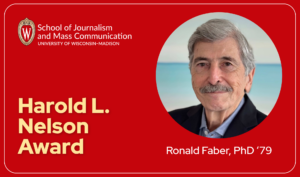
Upon completion of his PhD degree at Wisconsin, Ronald Faber began his teaching career as an Assistant Professor in the Department of Advertising at the University of Texas. While there, he rose to the rank of Associate Professor and was named the Houston Harte Centennial Fellow in Communications. He left Texas to become Associate, and then Full, Professor in the School of Journalism and Mass Communications at the University of Minnesota. There he was Co-Director of the School’s Communication Research Division for many years. He then served as Director of Graduate Studies until beginning a phased retirement. He is now a Professor Emeritus at Minnesota. After retiring he served on the Advisory Board for the University of Illinois’ Advertising Department.
As a teacher, Ron was passionate about helping students and young faculty succeed. He served as the advisor for numerous masters and doctoral students and mentored several faculty members in the early stages of their careers. Despite having retired 15 years ago he is still in touch with many of them today. Ron has been a prolific scholar, producing over 100 academic articles in several areas including children and advertising, political communications, advertising and media theory and effects, and compulsive buying. His research has been widely recognized. His articles have been cited over 20,000 times in other scholarly works and have received or been nominated for several top article awards. His research has also been reported on in numerous media outlets including the New York Times, Washington Post, Wall St. Journal, and CBS News. He received the Ivan Preston Award for Outstanding Contribution to Research from the American Academy of Advertising, and was also elected a Fellow of that organization, its highest honor.
He has been devoted throughout his career to enhancing the quality of work in advertising and marketing by serving on editorial, policy and advisory boards for several journals and research organizations. He was the editor of the Journal of Advertising for 4 years, during which, the Journal won an award for best research implications among marketing journals for 3 consecutive years. He is also one of the few academics to be asked by industry organizations to judge their awards for advertising effectiveness (EFFIE’s and AME). He is extremely grateful for all he learned while at SJMC, as well as the opportunity it gave him to meet his wife in one of his classes.
What does receiving this award mean to you?
Obviously, it is a great honor to be recognized by your peers and colleagues for your contributions to the field. I must confess I was surprised to receive the Nelson Award since much of my academic career was in advertising, consumer behavior, marketing and psychiatry, fields typically outside those viewed by most faculty in Journalism and Mass Communication. However, by teaching in the School of Journalism and Mass Communication at Minnesota I was lucky enough to teach and work with some exceptional graduate students, who are now SJMC faculty members at Wisconsin.
What is your favorite memory from your time at the SJMC?
While I have many great memories from my time in SJMC, my favorite, and the one I think of most often and fondly, was sitting after class one day and talking for hours and hours with a classmate about children and media. She is now my wife and, this February, that class will have been 50 years ago.
Who is one SJMC professor who made a lasting impact on your career, and why?
It is impossible for me to narrow it to one professor. The quantity and quality of the faculty in communication theory and research at Wisconsin was unbelievably great when I was getting my Ph.D. Jack McLeod and Steve Chaffee were there. Byron Reeves and Mark Miller had recently joined the faculty, and Robert Hawkins was also teaching here. So rather than naming a single person, I would have to say it was the environment that they had created together that had the greatest impact on me. There was a clear expectation of high-quality work, but in a very relaxed and collegial manner. There was a freedom to work on whatever you wanted, but if you wanted help or advice both the faculty and fellow graduate students were always willing to try to provide it. It felt like being a part of a large extended family.
What is one thing you learned at the SJMC that you have carried with you throughout your career?
The value of the learning environment I found at Wisconsin (see answer above). I learned a lot in classes, but so much more in my interactions with faculty and fellow students outside of class. It not only provided me with the knowledge and skills to be a good teacher and researcher, but it also gave me insight into all the tiny things that are part of being a good scholar and mentor along with the motivation to achieve these goals. Wherever I was I tried to recreate that environment. I feel extremely lucky to have been here when I was, and I hope I was able to, to some degree, pay it forward to my students.
What has been keeping you busy since your time at the SJMC?
While I was still working, work kept me busy. My research, editing the Journal of Advertising, manuscript reviewing, committee work, working with students, etc. Since retiring I have slowly stepped away from work related activities and taken up golf and pickleball, going to movies, plays, concerts, and lectures, walking around the lakes in Minnesota and on the beach in Florida, and keeping up contact with several of my former students and colleagues.
What are you currently focused on in your career?
Since I have been retired for over 14 years, I am no longer very focused on my career. I still serve on a few editorial boards, but I am slowly dropping all of these. Other than that, the only things from my career that I still do are talk or spend time with colleagues and my former students (and some of their students), and on a few occasions give talks on my research in compulsive buying.