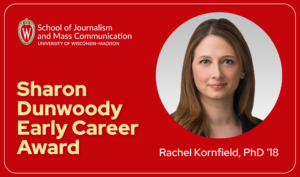
Rachel Kornfield, PhD, is an Assistant Professor in the Center for Behavioral Intervention Technologies (CBITs) in the Department of Preventive Medicine at Northwestern University’s Feinberg School of Medicine. A health communication scientist, she studies how digital and AI-enabled tools can be designed to strengthen mental health support, self-management skills, and access to care.
Dr. Kornfield received her PhD in Mass Communication from the University of Wisconsin–Madison, where her dissertation examined social support processes within online peer support communities. She completed her postdoctoral training at Northwestern University, where she expanded this work into the design and evaluation of scalable digital mental health interventions within clinical and community settings. Since joining the faculty at Northwestern, Dr. Kornfield has built a research program focused on digital mental health tools that deliver supportive communication at scale and adapt to users’ changing needs. She leads and collaborates on NIH-funded projects that design and evaluate AI-supported conversational agents, SMS-based interventions, and family-centered digital programs addressing depression, anxiety, and substance use disorders. Her work includes Small Steps, an SMS-based mental health support program deployed to more than 5,000 individuals self-screening for mental health conditions online. Across projects, she integrates user-centered design, randomized controlled trials, optimization trials, and community-based research methods to ensure that interventions are engaging, clinically meaningful, and sustainable in real-world settings. Her research has additionally been supported by Microsoft Research and the Australian Future Fund.
Dr. Kornfield’s work appears in leading journals across communication, digital health, and behavioral medicine, and she regularly presents at interdisciplinary conferences spanning health, social science, and human-computer interaction. She mentors graduate students, postdoctoral fellows, and research staff. Through her research and mentorship, she aims to shape how digital mental health tools are designed, evaluated, and implemented at scale.
What does receiving this award mean to you?
It’s a huge honor to receive this award. During my time at Wisconsin, I was deeply influenced by the tradition of rigorous, collaborative, and innovative communication research that Sharon Dunwoody helped shape, so being recognized in her name feels especially meaningful. It’s also affirming to see work at the intersection of communication, technology, and mental health recognized by the field. Much of my research is collaborative and applied, so this award reflects not just my own efforts, but also the students, colleagues, and partners I’ve been fortunate to work with along the way.
What is your favorite memory from your time at the SJMC?
I have so many fond memories of my time in Madison, and I really miss it. I loved spending time with my classmates on campus as well as exploring the shops, bars, restaurants, and parks around town. My favorite place to spend time was probably the Memorial Terrace. We would often gather there after long days, and students and faculty would stop by to chat. It was a beautiful setting with a strong sense of camaraderie, and of course, good beer and cheese curds.
Who is one SJMC professor who made a lasting impact on your career, and why?
I worked with many amazing professors, but the mentorship I received from my PhD advisor, Dr. Dhavan Shah, had the greatest impact on my career. Dhavan has an exceptional command of communication research and methods, and he consistently helped me see new angles on research questions and connections to related work. He is also deeply committed to research and to his students. An academic career can be challenging in many ways, and Dhavan showed me that those challenges are manageable when you bring curiosity and dedication to your work. He supported his students in research, professional development, and personal growth, and he took the time to know us as whole people. Now that I am increasingly in a mentoring role myself, I draw on his example often, and I still turn to him for mentorship.
What is one thing you learned at the SJMC that you have carried with you throughout your career?
I was fortunate to work with Dr. Al Gunther before he retired. In his class, he shared examples of real-world studies and how their findings were interpreted by researchers or covered in the press. Our job was to figure out whether the claims actually held up once you looked closely at the study design, including whether there were biases or alternative explanations hiding in the details. That experience taught me to look beyond headlines and pay close attention to how evidence is produced and interpreted. I still carry that lesson with me when reading research and when thinking carefully about the limitations of my own work.
Another important lesson I learned at Wisconsin is that no single method is inherently better than another. What matters most is whether the method fits the research question. My current work is mixed-methods. I conduct clinical trials and other experimental studies, and I also regularly use qualitative methods to understand how people use and think about technologies and how and why digital interventions work. I’m grateful that my training at SJMC exposed me to such a wide range of approaches that I can draw on.
What has been keeping you busy since your time at the SJMC?
I am now an Assistant Professor in the Feinberg School of Medicine at Northwestern University, and I really enjoy my work. Most of my projects are grant-funded, team-based research studies focused on improving mental health support through digital tools. This work keeps me busy, especially as unmet mental health needs have continued to grow since I finished my PhD. Outside of work, I enjoy cooking, watching movies, spending time with my husband, exploring Chicago, and visiting new parks with my two herding dogs.
What are you currently focused on in your career?
My current work focuses on understanding the implications of emerging technologies for mental health, including how generative AI is being used in digital mental health contexts. Generative AI introduces new opportunities for support, but also important risks. Many people are already turning to general-purpose conversational AI tools for mental health disclosure and support, even though these systems were not designed for mental health use. While users often value the potential for personalization and nonjudgmental interaction, they also talk about important risks like bad advice, over-reliance, and the displacement of human relationships. Much of my work aims to understand how people are using these technologies and to help the field make thoughtful decisions about how AI-enhanced digital tools should be designed and used.