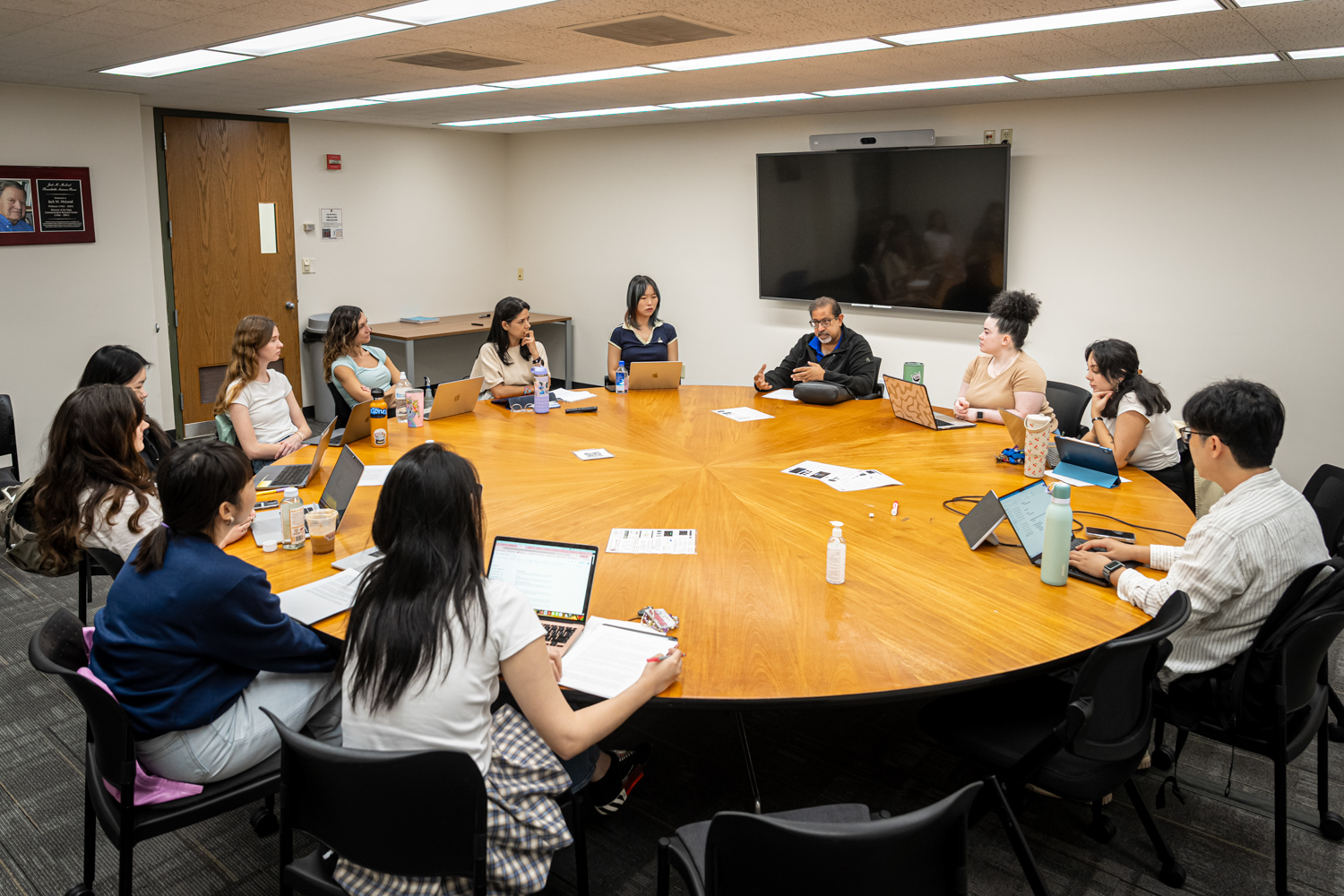
The Association for Education in Journalism and Mass Communication (AEJMC) selected Dhavan Shah, Jack M. McLeod Professor of Communication Research, as the recipient of the 2026 Paul J. Deutschmann Award for Excellence in Research. The award recognizes those who have established influential and substantial research records in the study of mass communication. Shah was awarded this honor for his prolific contributions to the field of mass communication and the influential research he conducted while at the University of Wisconsin–Madison.
Shah received the AEJMC Paul J. Deutschmann Award after over 30 years of advancing political communication, health communication and computational social science research.
“It means a great deal,” Shah said. “AEJMC has been one of my intellectual homes for much of my career, so receiving the Paul J. Deutschmann Award is both humbling and deeply gratifying.”
Shah’s research focuses on how communication can help people make better decisions, feel more supported and participate more fully in the world around them. Shah has dedicated most of his career to understanding how news framing, partisan media, digital platforms and political talk shape public opinion, social trust, civic engagement and political participation. He extended this work to examine the role of health communication in enhancing the quality of life for people managing chronic illnesses. Shah’s work has analyzed online cancer support, addiction recovery and vaccine messaging through a combination of conventional and computational research approaches.
“What makes the award especially meaningful is that it recognizes research that tries to connect theory, method and public purpose — work aimed at understanding issues like polarization, civic erosion, misinformation, health disparities, cancer care, addiction and aging,” Shah said.
Shah began studying the effects of communication as an undergraduate at UW–Madison under the guidance of renowned SJMC faculty members, including the late Jack McLeod, Ivan Preston, Sharon Dunwoody and James Baughman. Those early experiences motivated him to dive deeper into the impact of communication on politics and health. Now, decades later, Shah will be the recipient of the AEJMC Paul J. Deutschmann Award as a professor at his alma mater and one of the most decorated researchers in his field.
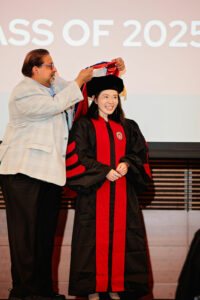
“I also see it as recognition of many students, collaborators, mentors and colleagues who have shaped this work. Much of my career has been built around collaboration and team science,” Shah said. “The award is a recognition of all of this collective work.”
Throughout Shah’s impressive career, he has advised over 35 PhD’s and served as a committee member on more than 100 dissertations across nine departments. As the Director of the Mass Communication Research Center (MCRC) and Research Director at the Center for Communication and Civic Renewal (CCCR), the group’s work has appeared in 200 articles across leading communications outlets. He has also co-authored or co-edited six books, including two published by Cambridge University Press. His prolificacy places him among some of the most renowned SJMC faculty in history.
“In earning this tremendous honor, Dhavan joins a group of distinguished SJMC emeritus faculty who also won – Sharon Dunwoody, Ivan Preston, Jack McLeod, Harold ‘Bud’ Nelson and Ralph Nafziger,” Director of the UW-Madison School of Journalism and Mass Communication Kathleen Bartzen Culver said. “No university has as many Deutschmann Award winners as UW–Madison, a true testament to the research contributions, creativity and dedication of this remarkable faculty. We could not be more proud of him.”
Some of Shah’s recent research examined the potential and limitations of Large Language Models (LLMs) to simulate human collective behavior. Today he is continuing his work exploring the impacts of emerging technologies on mass communication.
“I hope my work helps show how central communication is to political and health systems,” Shah said. “New tools like machine learning, computer vision and AI are powerful, but they matter most when connected to enduring questions about meaning, influence, inequality, incivility and public life.”
Shah’s achievements will be honored on August 5 at the AEJMC 2026 Conference in New Orleans, Louisiana.