 A warm cup of tea and shelves lined with books offer a glimpse into Assistant Professor Jing Wang’s world, where understanding people matters as much as understanding new technology.
As AI becomes more and more part of our everyday lives, Wang, an anthropologist of media, is interested in the questions that technology itself can’t answer: what makes us human and how can we as researchers better understand the emotions and experiences that make us human?
“It’s not the AI itself. Someone designed AI. Someone designed this specific tool,” Wang said.
For Wang, understanding AI is about going beyond the capabilities of the tool itself and asking who made it, how people use it and who bears the consequences. Her new lab, the Global Media Ethnography Lab (GMEL), aims to answer those questions and more.
Wang uses ethnography, emerging into people’s everyday lives, to understand how media and technology shape our experiences. It’s not just about the data, it’s about the way people actually live with the technology and the emotions and relationships that are involved in that.
“There are so many things that cannot be captured by algorithms,” Wang said. “There are so many things AI cannot feel. It doesn’t have a body.”
The distinction is particularly seen as AI tools become part of our everyday lives. In Wang’s interview, Otter, an AI transcription service, was used to record the conversation. Of course Otter makes the process of transcribing interviews a lot easier, but it also brings into focus issues around privacy, consent and what happens to the recording once it’s uploaded.
For Wang, convenience is only one element of the equation. It’s important to think about who has access to the technology, whose data is being collected and who might be negatively impacted by that.
“Who has greater access to certain technologies which put them ahead of other people and how do we mitigate those harms?” Wang said.
These questions are among those Wang hopes to explore through GMEL. When she arrived at UW–Madison in 2023, she had not planned to establish a research lab. But as she got to know students and faculty, she saw a shared interest in fieldwork and ethnography as methods for studying communication. For instance, Wang works with SJMC PhD student JD Duncan, the digital communications coordinator for GMEL, who plays an instrumental role in designing the website and managing its digital presence.
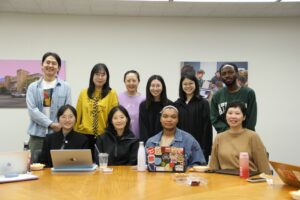 Wang saw an opportunity to bring those interests together in a space where researchers could learn from each other. It wasn’t just about creating a place to do research and publish papers. She wanted to create a community where students and staff could come together, talk to each other, discuss the shared questions they were interested in and build relationships.
“Having a community that shares similar research interests, shares maybe similar questions so that we can solve together, and also honestly making friends is very important,” Wang said.
That vision shapes the lab’s work. Student fellows meet monthly to discuss their research and explore opportunities to collaborate. They are also developing a shared digital library of resources on digital ethnography and ethnographic writing in media and communication studies, giving researchers materials to draw on in their own work.
 GMEL also brings conversations beyond campus through an online series of talks featuring scholars in ethnography, digital media and communication. One recent speaker was Dr. Daniel Miller of University College London, a world-renowned expert in digital ethnography. Another speaker was Dr. Saskia Witteborn of the Chinese University of Hong Kong, who delivered a fascinating talk on artificial intelligence and the question of context in fieldwork-driven research.
Wang is looking to expand the series to include more researchers from the U.S. and indeed from around the world. She shared how she tries her best to choose times that make the talks accessible to everyone. The lab is also looking at starting a student-run podcast, field trips and community-based projects that would link the research to people beyond the university. She is looking to deepen the human connection.
For Wang those connections are another way of understanding technology through the people who use it. She actively encourages members of the community who are interested in the production and use of media to get in touch with the lab, bringing in perspectives that the researchers might not otherwise have.
Studying the tool itself can tell you what it does, but listening to the people who make it and those who use it can tell you why it’s important and who it actually impacts.
As AI continues to transform the way we communicate and do research, Wang hopes that GMEL will inspire researchers to look beyond what technology can actually measure and to pay attention to the people involved. As AI gets more and more capable, her work comes back to something that AI technology can never do – the need to understand one another.