Assistant Professor Miya Williams Fayne’s new book examines how digital Black news outlets are reshaping journalism through content, ownership and audience.
Assistant Professor Miya Williams Fayne has spent over 12 years examining a question at the intersection of journalism, race and digital media: How has the Black press evolved in the digital age while continuing to serve its communities?
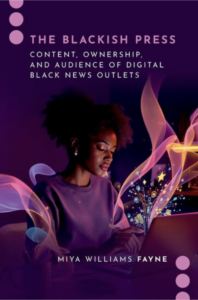
Her new book, The Blackish Press: Content, Ownership, and Audience of Digital Black News Outlets, released July 29, explores that question through interviews with journalists, audience research and digital analytics. The book represents years of scholarship dedicated to understanding an essential – and often overlooked – part of the media landscape.

“I feel an incredible sense of accomplishment in writing a book that represents my research interests. The Blackish Press is the culmination of my research agenda over the last 12 years and it is extremely gratifying to see all of my insights on the digital Black press to date available in one place,” Williams Fayne said. “This is a book that I would have wanted to read as a grad student and I hope the findings remain relevant and serve as a foundation for others to build upon.”
Williams Fayne’s interest in the evolution of the digital Black press began prior to her PhD journey. After completing her master’s degree in publishing and writing from Emerson College, Williams Fayne began working as an editorial assistant for Jet magazine and eventually for Ebony magazine, both of which were print publications that served the Black community. Over time however, she saw her friends opting for digital Black news websites, such as The Root and The Grio, and wondered why there was such a disconnect between the target audience of the print outlets and the staff and executives who ran them.
Eventually, Williams Fayne realized she wouldn’t be able to explore this disconnect further as a journalist, so she decided to pursue a PhD. As she began her PhD program at Northwestern University in 2014, she was surprised to find that there wasn’t much scholarship on the digital Black press. Most research focused on the historical Black press from the first Black newspaper in 1827 to publications in the 1970s, and there were only a handful of articles discussing the Black press in the 21st century. Williams Fayne was instantly inspired to fill that gap in scholarship.
“This book is a professional milestone because I believe it further establishes my research in the field of journalism studies,” Williams Fayne said. “I am excited for faculty, students, and the general public to read my work on a topic that I am really passionate about.”
While conducting her research for the book, Williams Fayne was most interested in redefining the Black press in the new media age and updating the three areas that were previously used to define the historical Black press: advocacy content, ownership and target audience.
“In my interviews with Black press journalists and during my focus groups with Black press readers I asked if advocacy was a necessary component of Black press content or if entertainment content should still be included in conceptions of the Black press. I also asked if ownership or target audience mattered,” Williams Fayne said. “I wanted to know if journalists and readers viewed digital Black press outlets (especially those that primarily produce entertainment content) similarly to print outlets or if they were conceptualizing them differently.”
Williams Fayne titled the book The Blackish Press, to emphasize how digital Black press outlets are both similar to and different from historical Black press publications. She ultimately argues that the Black press is valuable regardless of the type of content it produces. Her research finds that even when Black press outlets produce entertainment content, they are still advocating for the Black community and providing additional representation of African Americans.
“I hope people see the importance of the Black press as it continues to counter the stereotypical and negative representations of African Americans found in mainstream news,” Williams Fayne said. “I also hope that after reading the book, more journalists and future journalists look to the Black press as an exemplar for how to cover the Black community accurately and fairly.”
 Part of Williams Fayne’s research focused on analyzing web metrics from digital Black press outlets. What she discovered through that analysis turned out to be one of the most surprising findings that emerged from her research.
“I was surprised to learn that although Black press editors are targeting a Black audience, the majority of unique visitors to Black press websites are not Black,” Williams Fayne said. “When I analyzed the audience for Black press outlets across desktops, smartphones and tablets, I found that the non-Black audience comprises an average of 59 percent of the unique visitors with the Black audience comprising the remaining 41 percent. Also, the Black audience accounts for an average of 50 percent of the time spent consuming Black press outlets, and the non-Black audience constitutes the other 50 percent. This means that the Black audience and the non-Black audience spend the same amount of time engaging with digital Black press content.”
As fellow scholars, graduate students and the public begin to read The Blackish Press, Williams Fayne hopes that it spurs further conversations about not only the Black press but about the media landscape at large.
“I hope this book gets people to discuss the significance of media ownership. Most journalists and readers I spoke with do not believe that ownership is required in order to be considered a Black press outlet. However, many believed Black ownership of Black-targeted news outlets was ideal. As some digital-native news websites are now coming under Black ownership, we may see changes in the priorities of these organizations,” Williams Fayne said. “Also, with recent changes in ownership at mainstream media networks it is even more important to consider who owns news outlets and the potential consequences of that ownership on the publication’s content.”
While the publication is a much needed contribution to journalism studies scholarship-, Williams Fayne hopes The Blackish Press will serve as the beginning of continued research and conversation about the modern day Black press.
“Writing this book was truly a labor of love. What began as dissertation research has been extended, clarified, revised, and reimagined. I am happy to say that The Blackish Press is now a finished product that I am proud to share,” Williams Fayne said. “I look forward to discussing the book with readers and hope it encourages other scholars to study and value the contemporary Black press.”
The Blackish Press: Content, Ownership, and Audience of Digital Black News Outlets is available now through Oxford University Press.